ORGANS OF PARIS © 2026 Vincent Hildebrandt HOME ALL ORGANS



This big and very majestically positioned church was
built during the reign of Napoleon III by the architect
Louis-Antoine Heret, in a neo-Romanesque style with a
visible metal structure. Built at the top of the hill of
Ménilmontant, the forecourt had to be arranged with
54 steps to make up for the difference in level
between the façade and the apse. It is the third-largest
church in Paris in terms of length and slate roof
surface. The roof is supported by a wooden frame
resting on metal beams, which complete cast-iron ribs
visible beneath the nave vaults. It was the first church
in Paris to have a visible metal structure.

C1
The organ of Notre-Dame-de-la-Croix is one of the few
organs in Paris built by Cavaillé-Coll that has not
undergone major alterations.
The organ was built between 1872 and 1874. When
designing the instrument, Cavaillé-Coll faced two major
technical problems caused by the large rose window and
the passage for the bells through the middle of the organ
loft. Because of its architectural and theological
importance, the rose window had to remain fully visible
from the lower part of the nave, so that the nine crosses in
it could be seen. Cavaillé-Coll therefore had to build the
case in two separate sections. He also had to place the
console at the edge of the gallery to leave enough space
for the bells to be lowered through the middle. These
constraints led to a major change in the original design.
Indeed, the first estimate called for a three-manual organ
with an expressive Récit, Grand Orgue, expressive Positif,
and Pedal.
After the Récit and Grand Orgue had been installed, it
became clear that there was no room left for the Positif.
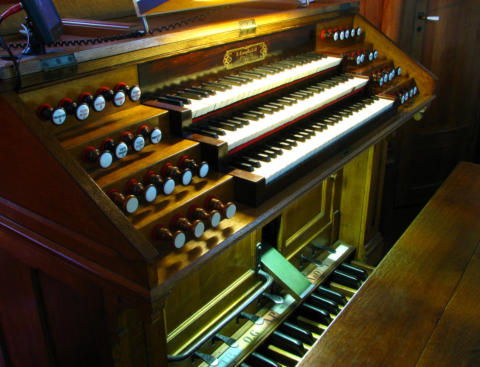
Since the console was already in place, the first manual
was turned into a permanent coupler manual, meaning
that it couples the Récit to the Grand Orgue. To
accommodate the bell passage, Cavaillé-Coll was forced to
turn the console around so that it faced the rose window,
and to devise a complex mechanical action.
The right-hand case contains the Grand Orgue pipes,
placed high up. In the lower section are the action, part of
the wind system, and the Barker machine.
The left-hand case contains the Récit, whose pipes are
enclosed in a swell box. This box has shutters that can be
opened or closed with an expression pedal at the console.
Right next to it is a large empty space that was meant to
hold the Positif’s 11 stops.
At the back of the organ loft is the Pedal division, arranged
on both sides with the main bellows in the center. The
pedal pipes are open to the air. The largest pipes, 16-foot
ranks, are about 5.5 metres high and 45 centimetres wide,
which is exceptionally large.
1912
Charles Mutin renovated the organ and raised the wind
pressure.
1922
Overhaul by Fernand Prince.
1955
Erwin Müller modified two stops: the 4' Octave in the
Grand-Orgue became a 2 2/3' Quinte; the harmonic
progression of the Plein Jeu III-VI in the Grand-Orgue was
modified to become a Plein-Jeu III-IV with breaks (C = 1 1/3,
c = 2, c' = 2 2/3', c'' = 4).
1989
The organ was restored by Daniel Birouste (Plaisance) with
a limited financial budget.
2010
Overhaul by Hubert Brayé. An important work of
equalization, especially concerning the reed stops, was
carried out.
Although this organ has only 26 stops, the instrument has an
amazing power and it can be described as one of the finest
Cavaillé-Colls in Paris.
Site of the organ

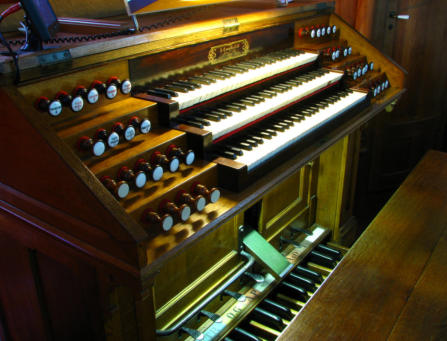

Photo : Christopher Marx
1874 - Cavaille-Coll (1)
1912 - Charles Mutin (6)
1922 - Fernand Prince (6)
1955 - Erwin Muller (3b)
1990 - Daniel Birouste (5)
2010 - Hubert Brayé (6)
III/26 - mechanical traction -
stoplist

Titular organist
Frédéric Denis
Famous organists in the past :
Gaston Litaize (1930-1932), Jean Langlais (1932-1934)
Parish website
Videos
Frédéric Denis
Audio
Frédéric Denis (grand orgue), Eliane Stefan (orgue de
choeur) - Grand choeur dialogué - Eugène Gigout
Frédéric Denis (grand orgue) - Carillon de Westminster -
Louis Vierne
photos
Buffet : Jeroen de Haan
Console : Pierre Marteaux
Eglise : Vincent Hildebrandt
Other photos








Organs of Paris


ORGANS OF PARIS © 2026 Vincent Hildebrandt
C1
The organ of Notre-Dame-de-la-Croix is one of the few organs
in Paris built by Cavaillé-Coll that has not undergone major
alterations.
The organ was built between 1872 and 1874. When designing
the instrument, Cavaillé-Coll faced two major technical
problems caused by the large rose window and the passage
for the bells through the middle of the organ loft. Because of
its architectural and theological importance, the rose window
had to remain fully visible from the lower part of the nave, so
that the nine crosses in it could be seen. Cavaillé-Coll
therefore had to build the case in two separate sections. He
also had to place the console at the edge of the gallery to
leave enough space for the bells to be lowered through the
middle. These constraints led to a major change in the
original design. Indeed, the first estimate called for a three-
manual organ with an expressive Récit, Grand Orgue,
expressive Positif, and Pedal.
After the Récit and Grand Orgue had been installed, it
became clear that there was no room left for the Positif.
Since the console was already in place, the first manual was
turned into a permanent coupler manual, meaning that it
couples the Récit to the Grand Orgue. To accommodate the
bell passage, Cavaillé-Coll was forced to turn the console
around so that it faced the rose window, and to devise a
complex mechanical action.
The right-hand case contains the Grand Orgue pipes, placed
high up. In the lower section are the action, part of the wind
system, and the Barker machine.
The left-hand case contains the Récit, whose pipes are
enclosed in a swell box. This box has shutters that can be
opened or closed with an expression pedal at the console.
Right next to it is a large empty space that was meant to hold
the Positif’s 11 stops.
At the back of the organ loft is the Pedal division, arranged on
both sides with the main bellows in the center. The pedal
pipes are open to the air. The largest pipes, 16-foot ranks, are
about 5.5 metres high and 45 centimetres wide, which is
exceptionally large.
1912
Charles Mutin renovated the organ and raised the wind
pressure.
1922
Overhaul by Fernand Prince.
1955
Erwin Müller modified two stops: the 4' Octave in the Grand-
Orgue became a 2 2/3' Quinte; the harmonic progression of
the Plein Jeu III-VI in the Grand-Orgue was modified to
become a Plein-Jeu III-IV with breaks (C = 1 1/3, c = 2, c' = 2
2/3', c'' = 4).
1989
The organ was restored by Daniel Birouste (Plaisance) with a
limited financial budget.
2010
Overhaul by Hubert Brayé. An important work of
equalization, especially concerning the reed stops, was
carried out.
Although this organ has only 26 stops, the instrument has an
amazing power and it can be described as one of the finest
Cavaillé-Colls in Paris.
Site of the organ
1874 - Cavaille-Coll (1)
1912 - Charles Mutin (6)
1922 - Fernand Prince (6)
1955 - Erwin Muller (3b)
1990 - Daniel Birouste (5)
2010 - Hubert Brayé (6)
III/26 - mechanical traction -
stoplist
Organiste titulaire
Frédéric Denis
Organistes célèbres ayants illustré l’instrument :
Gaston Litaize (1930-1932), Jean Langlais (1932-1934)
Site de la paroisse
Vidéos
Frédéric Denis
Audio
Frédéric Denis (grand orgue), Eliane Stefan (orgue de
choeur) - Grand choeur dialogué - Eugène Gigout
Frédéric Denis (grand orgue) - Carillon de Westminster -
Louis Vierne
photos
Buffet : Jeroen de Haan
Eglise : Vincent Hildebrandt